Broken Bow, Nebraska
Several years ago I did a drive out West and back East. Two different routes, two totally different landscapes, experiences, people, history.
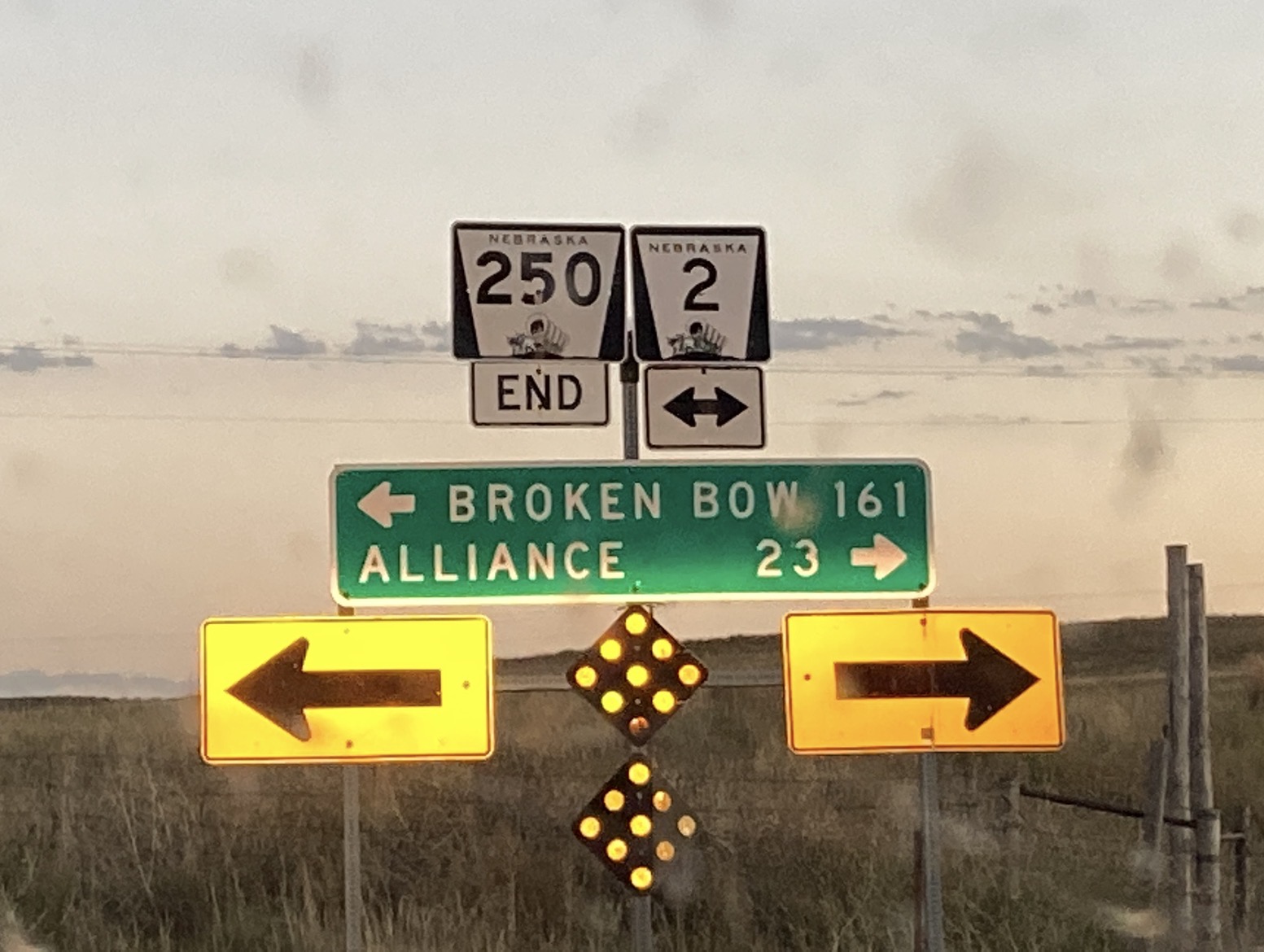
While cutting across Nebraska, from its most northwestern corner to Omaha, a road sign caught my attention. Hard to miss it, as it was staring me in the face. It said “Josh, you can go that way, or the opposite way, these are your limited choices here.”
Picture of it below.
This sign at that “T” intersection symbolized then and even more so now the strange fulcrum America is balancing on. Back then America was undergoing the shock of the wide open borders, the mass migration of illegal aliens and their subsequent mass crime wave; the Biden DOJ’s declaration of war on everyone who was not part of their political “tribe.” The illegal invasion of President Trump’s home at Mar A Lago, based on the fake accusations of politicized lawyers. Etc.
At that “T” intersection, one could go one way to the tiny cow town of “Alliance.” The other direction was to “Broken Bow,” also a small ranching town in the middle on Nebraska, which is truly the definition of the Middle Of Nowheresville. No other choices were available. No straight ahead, just two completely opposite directions, left or right.
While we all encounter “T” intersections while driving, it was the names on the signs and the starkness of the empty surroundings out there on the American heartland prairie that caught my attention that moment. They were so evocative of the choices we faced then, before the 2024 election, and it reminded me of a popular meme from probably 2022 that says “You are here” at a “T” intersection, with your choice being “Communism” on the left turn and “America” on the right turn.
Broken Bow, Nebraska, gets its name from, yes, you guessed it, the 1860s Indian Wars. A broken bow is a symbol of failed war, lost battle, a lost war, defeat. I think “Broken Arrow” is the US Army call sign for a pending overrun of US positions by enemy infantry. The Fasces, the symbol of ancient Rome and Mussolini’s 1940s fascist Italy, is a bunch of arrows all wrapped up together, and thus unbreakable. So this kind of imagery is evocative to everyone, at all times in human history.
Out there on the Nebraska prairie that day, the other choice at the “T” was “Alliance,” a name also evocative of military maneuvers, strategies, tactics, and also cultural cohesion, different people agreeing to stick together for their common good.
What a juxtaposition: Defeat on the one hand, or survival on the other.
Maybe I see too much symbolism in things that are really just mundane, but it is how my mind works, and so I also envision that this upcoming election in America is representative of this kind of analysis or interpretation of the natural phenomena and the built world surrounding us. The ephemera of past human conflicts and choices and decisions around us are neon bright reminders that we repeat history, and hopefully have learned from it.
We all of us, each of us, have choices, every minute of every day, and we all have agency, our own unique ability to apply and implement ourselves, our passions, our desires, our hopes, our dreams into the world around us. Some aim high and think big, others less so. It is all important.
At our very individual best, we are capable of great changes at times when we and others least expect it.
To me, I see America right now at that crossroads out there in the endless Nebraska grassland, facing a stark choice, two opposing directions, mutually exclusive.
On the one hand, America can elect people to Congress who will implement policies that result in a broken American bow. Policies that resulted in the terrible destruction of the 2020 riots here, and also the terribly destructive riots in Europe the past week, to say the least. Open borders, Medicare for everyone who mass migrate walks across the border, “free” taxpayer funded stuff on top of “free” taxpayer funded stuff for anyone and everyone from around the world…this is not sustainable, it is not an adult or responsible way to think about limited money, or limited resources. It is inevitably destructive of our civilization, and why oh why would any taxpaying American citizen vote for their own, our own, destruction?
On the other hand, Americans can elect representatives to Congress who want an alliance, which is cultural cohesion, holding down the fort, protecting the fort, protecting the American People tribe from further defeat or damage. An American society built on mutual benefit, fairness, which to date our nation has been. Sometimes more, sometimes less, but even at our worst still infinitely more and better than any other nation on the planet.
Hopefully, my fellow Americans see this coming Election Day as the choice between Broken Bow and Alliance, and they choose Alliance. I won’t talk about political parties, because neither one impresses me. One is crazy, the other is lazy. But I will take lazy and non-destructive over crazy and totally destructive every day of the year. Especially on Election Day this year.
Your vote is your agency, your impact, and I hope you use it for the alliance, and not for breaking things.

Screenshot







Screenshot
America’s choice in ten days

Screenshot
Ruger is about to be eaten alive
While the American gun world is presently enthralled by the ATF’s latest effort to deep-six the NFA and emasculate the GCA, and make SBRs and sawed-offs and suppressors available for all, we have something much more prosaic to discuss here. And it sucks.
Bill Ruger, Sr., was a famously driven man, a true American, who from his earliest adult years made unique, high quality guns that he wanted to make. These were firearms not yet on the market by any other manufacturer, and with no indications that there ever would be a market for them. They were often modeled after guns that had at one time been centerpieces of the foreign sporting world, like elegant, accurate British and Scottish-made Farquarson action single shots. And yet the markets followed him. In fact, Bill Ruger created markets not just for his own guns, but for whole categories of guns that Americans had not shown interest in for a hundred years, if ever.
Like the Ruger #1, a single shot, based on the Henry/ Farquarson action. Simple, rugged, exceptionally accurate, capable of all kinds of Africa-scale rounds. He also made side-by-side shotguns, and over-under shotguns, when both were falling out of favor to blastemall semi-autos. In fact, many younger Americans had never actually seen a double barreled shotgun in person, when Ruger brought his Red Label onto the market. Like the Bearcat and subsequent revolvers, introduced at a time when cowboy-style guns were long out of style.
Bill Ruger adapted investment casting for many of his firearms, which saved a lot of money in laborious machining and turning raw stock. He revolutionized modern gun manufacturing so well that competing companies, like Colt, began chasing the new markets that Bill Ruger had opened, often adopting his manufacturing methods in part or in full.
One of my favorite rifles is a 1980s Ruger M77 RSI International .308, that is as light and as pointable as a stalk of goldenrod, as accurate as a laser, and easy to carry all day long. Because it is so exceptionally light, short, and handy, and has a thumb safety on the tang, it is exceptionally fast on snap shots while stalking deer and bear in the mountains. My M77 RSI has killed countless deer and one bear. But the challenge with the M77 RSI is that Ruger had the short, thin, finely tapered barrels milled with the scope mounts integral to the barrel. Like the Germans used to do (and occasionally still do) on their finest sporting rifles. While a fabulous little work of art, the manufacturing costs for this gun were too high, and it was discontinued in the early 1990s. Tang-safety M77s were made a few years more, and then the ridiculous wing safety was used on all subsequent M77s. No still hunting for you!
Recently, Ruger bought out the old Marlin machinery from the old Remington plant in Ilion, New York. I toured that factory about fifteen years ago, and what a loss that it is now gone, that the workers there are gone, that the Remington name is now gone from the town of its founding after more than two hundred years. Crappy or shady business practices caused the new-new-new Remington to fail, even though it produced many good products. Though the old Marlin 1895 was not well made in the Remington plant, with “Remlin” rifles pretty low on the totem pole.
Well, Ruger took the lever action world by storm when it resuscitated the Marlin 1895 a few years ago, in its state-of-the-art Mayodan, North Carolina plant. Flawless, incredibly accurate, reliable, rugged, this stainless lever gun in its original 45-70 became the go-to for Alaskan big game guides in grizzly country. It is the gun I take hunting in Alaska. I have killed several deer and a bear with mine. One shot kills, one at 160 yards with open sights (my eyes are aging and that kind of shooting just ain’t happening any more, sadly).
And Ruger has also continued to make all the oldies-but-goodies that are cornerstones of the gun owning world: The GP100 .357, .44 Mag Redhawk, .44 Mag Blackhawk, .45 Colt Vaquero, and Bearcat revolvers, the Ruger Number 1 single shot, and the M77 series of rifles, among others.
Ruger can continue to run a perfectly successful business making these “legacy” models, because while their markets are not on fire, like the 1895 is, they are steady. Their customers want them. Not by the truckload, but enough to keep several highly trained workers busy full-time, and money coming in steadily.
But Ruger is about to be eaten alive in a foreign corporate takeover, and the company has already notified its customers that it is dropping an awful lot of the oldies-but-goodies, including most of the revolvers. Whether this decision is a tactical retreat under the turtle shell by current ownership, in order to shed less-productive or under-performing, or expensive to make products, balance the books, and shield against the coming hostile takeover attempt, or is a giant flash increase in short-term profitability so that the takeover costs as much as it possibly can, who can say. The fact is, Beretta is gunning for Ruger, and it appears that they are likely to take over.
And Ruger is showing the signs of a prey animal. Tossing stuff overboard in an attempt to pick up speed as it flees its pursuer.
Forgive my national pride and my national interest bit, but I am not happy about losing another indigenous firearm manufacturing company to a foreign country. Yeah yeah yeah, Beretta is 500 and some years old. Whateva. Great. I like that. Good for Italy. But that means nothing of consequence to any of us Americans, when what we need are Ruger replacement parts easily obtainable here in America, sold to us by Americans on the phone.
Remington 3.0 went to the Great Gun Maker in the sky a few years ago. Winchester bounced back and forth between the Japanese and the Belgians, and now exists in some purgatorial form that occasionally shows up like a ghost, and then disappears back into the shadows, again. Colt has barely hung on, same for Smith & Wesson. America’s native gun makers are Henry, Taylor’s (which also imports quality Italian firearms), Barrett, a few other small shops specializing in hyper accurate sporting rifles. America needs all the gun makers it can get, making not just sporting weapons but military weapons, too. We cannot survive if we outsource our weapons acquisitions to foreign makers.
America needs Ruger. But it appears we are getting Beretta, and there is no way that firm is going to run the company the Bill Ruger way. Here comes the corporate slashing and bleeding, the loss of fabulous guns, and the loss of American jobs, in the name of maximum profit. Maybe Beretta wants a lever action shotgun, and is acquiring Ruger just for that. I guess that might be in the spirit of ol’ Bill.

Ruger’s M77 RSI International in .308, that has killed over a hundred deer in my hands, a bear, some other critters. Just recently topped with a now discontinued Leupold 1×5, perfect for the slow mountain still hunting I enjoy

Ruger Marlin 1895 in 45-70 with shed buck I shot in Dauphin County a few years ago. Laser accurate gun

Abandoned mine site in remote Alaska, five mile walk in from dead-end dirt road. Over a week of hunting this area, I saw moose and griz aplenty, heard a wolf pack howling, passed up on a smaller black bear I literally walked right up to and looked over. Having my own handloaded brass solids in the Ruger Marlin 1895 was the most reassuring feeling

Hunting in Alaska requires all kinds of layers, and waterproofs, rubber boots, and stainless rifles. The Ruger Marlin 1895 is my go-to gun for these trips
Oh Joni, you’re a mean ol’ granny but I like you
Aging hippie and outstanding musician Joni Mitchell became an American citizen this week. After sixty some years of living here, and benefiting from America, she finally became a citizen. She used her newfound freedoms and opportunities to immediately attack the guy responsible for her admission, President Trump.
It was the usual bad form, bad manners, lack of appreciation, and selfishishness of the political Left, who act like they were raised in caves by packs of wolves or lions.
Having been raised by hippies myself, which is like being raised by wolves, as well as being raised myself by an actual pack of wolves – no lie, absolute truth – I can both relate to much of Joni Mitchell’s music, enjoy much of her music, understand her weird counter-culturism, within the period that was her youth, while rejecting a lot of it for the corrosive immaturity it is, especially now, and also say “Joni, you are a mean old granny, but I like you.”
One of my favorite songs is Joni Mitchell’s “Carey,” which today serves as a time capsule or a time machine back to the freewheelin’ early 1970s. I recommend listening to it at least twice; once to hear the words, and twice to understand and envision them. If you binge listen to it a bunch of times, you are a normal and healthy person.
And while I am here lauding Joni Mitchell’s song, I would like to say that I wrote an eponymous apology letter recently. It is the epic apology letter of human history, and for the one young reader we have here, I can give you some advice: Follow your heart when you are young. Be like Joni Mitchell in that way, and go where your heart takes you. Be brave; do not let fear or uncertainty stand in your way. You will regret it. And if you do not regret it in your mature years, you have no heart, never did.
And Joni, honey, if you are a conservative when you are young, you have no heart, but if you are a liberal when you are old, you have no brain. You are still a hell of a talented musician, and please stop talking about politics. Forthalovagod.
Here are two versions of Carey: One where she gives a great on-stage introduction, and the produced version, which is easier on the ears, and thus easier on the mind creating mental images of 1970s Greek beaches… true freedom in a sense.
I saw China dumping today
Today, I saw tangible evidence of China just outright dumping its products at give-away prices, way below manufacturing cost. It was such a dramatic sight that it made me wonder why they are doing this. Come along with me on this trip, and see what conclusions you come to yourself about what we see together.
This morning I arrived at the Pine Run Auction in Linden, PA, good and early. Got my bidder card, #6, and walked around, looking at the items coming up for auction starting at 9:00am. Nearly everyone in attendence looked the same, dressed the same, was the same age. It was humorous, because when I threw on clothes this morning, I thought surely I would be overly rustic. Nope. We all looked the same, all the old rural northcentral Pennsylvania guys. Well, “old” is a relative thing; I was one of the younger men there. And the truly young were in their forties…..
Among the rusty old American farm machinery, tri-axles, crates of machinery attachments, tools, the almost-retired CAT excavators and the chipping and peeling John Deere bulldozers, lay piles, literally piles, heaps, of shrink-wrapped brand-new Chinese made machines. I mean piles. Brand new.
Being sold by the bushel.
Mini excavators and their extra attachments, mini skid steers, machines designed for the enterprising individual American man, sold for a few hundred dollars each. Barely their value as scrap steel. Photos below, if you doubt me.
Begging the question: What is China doing? Why are they taking these huge losses? Is China being beaten down by American tariffs, as our president said they would? Is China’s economy in free-fall? Is China in big economic trouble?
Or is China so wealthy and successful that they can afford to literally just give away their most expensive consumer products, at this huge loss? Imagine all of the myriad other little auction houses like Pine Run, all across America, all auctioning off these same machines, attachments, for pennies. This is a huge amount of steel, rubber, hydraulic fittings, and petroleum stuff being just wholesale dumped across America, by our biggest frenemy.
My impression is that this is the behavior of a drowning person.
Pine Run Auction of Linden, Pennsylvania, might be just one molecular data point in a galactic constellation of economic activity data points generated by one and a half billion human beings (America plus China). But there are calculus equations for calculating the slope (the direction) of a single data point, and while I can barely do one plus one type calculus, my gut instinct about today’s Pine Run Auction is that the Chinese economic slope is heading in a severe angle straight toward the planet’s surface in a huge flaming fireball.

Part of the bidding gang. A lot of bidders participated by Proxibid

Chinese mini excavators that should have cost thousands of dollars, sold for huundreds each.

Steel attachments for the Chinese-made excavators, many of which sold for more than the matching machine, because they will be re-fabricated and adapted for other American machines

Interesting concept, a mini-skid steer. Stacks of them. Selling for hundreds of dollars. How much did China pay to make these, versus how many pennies did they get back?

Cowboy hats and bib overalls, rural America, baby. Way off in the distance Bald Eagle Mountain is visible through the open bay doors
Oh, the ironies swirling around Columbus Day
Yesterday was Columbus Day, the traditional official day where Americans mentally or culturally mark the European discovery of what became America, also known as the New World.
Columbus Day has become a cultural battlefield, a friction point between cultural traditionalists, fair-minded empathists thinking of the displaced Amer-Indians, and cultural Marxists seeking to just tear down all of America and Western Civilization. That my calendars all say that yesterday was both Columbus Day and Indigenous People’s Day is evidence that the cultural Marxists are successful in penetrating into our national mindset and identity. This is more meaningful than the illegal defacement and vandalism of Christopher Columbus statues everywhere by knuckle-draggers performing as humans.
But oh, the rich ironies that surround all of this debate and discussion and deliberate, wilful ignorance on all sides!
Irony, one asks? Why yes, sh*t tons of ironic moments surround the Columbus debate.
First among them is the scientific fact (not theory) that Christopher Columbus was in fact…Chaim Colon… a Jew. How ironic is it that among the greatest modern tormentors of the Jews (the Spanish, and the Catholic Church) then became the greatest cheerleaders for one, when it suited their own cultural appropriation desires?
And is it not ironic that the evil 1492 Spanish total ethnic cleansing of the Jews from Spain, and the theft of their money, their businesses, their homes, and even their children, and their mass forced conversions and burning alive at the stake for religious “thought crimes,” then resulted in one of these same Jews fleeing the Spanish crime wave, and in his flight with a large crew of Jews aboard the Nina, the Pinta, and the Santa Maria, Columbus ended up locating a large and largely uninhabited continent upon which all abused people – Celts, Protestants, and Jews – could find refuge?
And was it not ironic that the barbaric Spanish Inquisition, which was really just a mass sadism, rape, pillage, and steal scheme by the Church (led by the ironically appropriately named Queen Isabella, which is the Latin name for Jezebel, the notoriously evil pagan Jewish queen of Biblical times), was so evil that it ended up creating the Protestant Reformation in response?
And that those same fleeing Protestants then populated Columbus’ “New World” and founded the free and prosperous America that we all know and love? That then relies upon the Jewish-Catholic Columbus as its modern day patron saint and national symbol?
Quite a cycle of ironies, stacked on top of one another.
And about this “Indigenous People’s Day” thingy bob: Who are these Amer-Indians? I mean yeah, we all know they most likely pre-dated the arrival of Europeans, but where did they come from, originally?
ASIA!
As if Asia is any closer to America than Europe…the take-away here being that the American Indians are themselves migratory transplants in America, also from a distant continent. They are, in effect, no different than Christopher Columbus, the Protestant Pilgrims at Plymouth Rock and Jamestown, or the subsequent waves of Italian and Irish and European immigrants.
I dunno, but maybe one human migration is the same as another? And if Europeans being here in America is some sort of huge racial crime, then what do we say about the mass invasion of Europe by non-Europeans? Should only fair-skinned indigenous Europeans inhabit Europe? They are the natives there, after all.
Native land is native land is native land, and trying to say that one native land is off limits to subsequent human migration, while the other native land should be wide open, is racially discriminatory. Which I think is actually the whole point of this cultural Marxism attack on Columbus Day and America’s Western heritage. If you ask me, it smells like an imperialistic Han Chinese plot to keep the Asian migration to America wide open, and the undermining of Western freedoms ongoing….
Whole new meaning to “October Surprise”
“October Surprise” is a phrase associated with last-minute, last-ditch, late-in-the-game efforts to damage political opponents right before the annual early November’s Election Day.
Usually based on outright lies, half truths, lies by omission, or some partial evidence of a candidate’s possible or implied failure of character or legality, the “October Surprise” is always cast as a dirty trick meant to make a strong candidate un-electable. An October Surprise is usually a fake smear, amplified by a partisan establishment media, though there are occasional last-minute information releases that are truthful.
Well, it is election season in America, and it is an important one, but tomorrow, October 7th, marks the other kind of “October Surprise.” Like the big, deadly attack that America experienced at Pearl Harbor in 1941, and which brought America directly into World War II. And while our subject October 7th was a surprise attack, and it resulted in a huge sadistic massacre of mostly civilians, it was not just about that one moment. Its implications are world-wide. Even though it occurred in one of the world’s smallest nations, inflicted upon one of the world’s tiniest groups of people.
Three years ago on October 7th, Islamic jihadis broke through the Israeli border near Gaza, and attacked friendly, trusting small villages and a world-love music festival (the Nova Festival). The invading Gazan jihadis committed unspeakable human rights violations, war crimes not seen since World War II, and sadistic atrocities that are unimaginable and even unbelievable to the normal person.
Unfortunately or fortunately, the Gazans proudly recorded their crimes, and the heart-breaking / soul-shocking footage is visible at a lot of websites. Babies burned alive in front of their parents, who were then raped and murdered. Lots and lots of gleeful torture by green-wearing Jihadis, who did the whole Allahu snackbar thing after each crime.
Islamic cruelty is not just a specially noted thing of past European history, or of our own 9-11 plane attack, or of the many crazy reports home from American wars in Iraq and Afghanistan. It is something naturally organic to that desert culture, which we got to see most recently in the 2012 civil war in Syria. Well, all of it was replicated on the Hamas-led civilian attack on Israeli Jews on October 7th.
And while October 7th was supposedly about Gaza, a place the Israelis had completely abandoned in 2005, it was really the opening salvo in a world-wide jihad against the West. Just like Arch Duke Ferdinand’s murder started the dominoes that triggered World War One, it appears that Gaza’s October 7th surprise attack was the beginning of a highly prepared, well coordinated world-wide jihadi assault on Western Civilization.
If there were such a thing as a Muslim peace movement, three years ago would have been the time to see it rise to the occasion. Instead, our planet has been enveloped in a unified mass invasion of Western nations, a massed political attack on Western democracies by the Red-Green Alliance of Islamic jihadis and Marxists, jihadi candidates for Congress and US Senate in Michigan. Using democratic processes and institutions to achieve non-democratic sharia-compliant end results, October 7th triggered an avalanche of attacks on America and Western nations.
October 7th, 2023, was the October Surprise of all October Surprises. Small place, small beginning, but enormous shockwave with civilization-ending implications still building up steam right now.
Tomorrow is October 7th, the modern day Day of Infamy. Folks, ya better try to get everyone around you to wake up. Before it is too late. You don’t have to be Jewish to enjoy Levi’s Jewish rye bread, and you don’t have to be Jewish to understand the deep threat to your family implied in October 7th.
You are in a civilizational conflict, whether you realize it, or not, whether you like it, or not.
One good reason to vote for Scott Perry
Scott Perry is the current congressman in Central PA. Has been for something like ten years, maybe twelve…fourteen? As political careers go, Scott is just about to enter the “been around a long time” category, a category I am normally leery of, because long term career politicians always lose touch with their constituents. They become institutions in their own right, and use that institutional hold to self-enrich, while hardly ever doing The People’s business.
Career politicians usually slide into cruise control mode and make pretend about doing something, bloviating, and then go on long vcations.
The fact that Scott has to work hard and campaign hard in a competitive district in order to hold on to his seat is a good thing. It is good for him, because it keeps him honest and responsive, and because it forces him to listen to his constituents. It is good for us, his constituents.
Scott Perry has several different reputations, some I understand and some I just do not understand. Some of these are well-earned, for better and for worse, and some are just bitch-and-moan partisan politics, which I categorially reject. I can say that I have had conversations with Scott where we disagreed, and where we agreed.
One of his good (I think) reputations is as an independent maverick, an independent thinker, his own man, who operates away from political party oversight and control. It is this way of conducting himself that has earned him my vote.
Where each political party has its own constellation of circling sycophantic self-interested parasite groups, say, teacher’s unions for the Democrats and tobacco for Republicans (it is a toss-up which is worse for you, the teacher’s union or constant tobacco use), the unusually rare career political reps like Scott Perry have constructed their own unique support network that is tailored to their own/ his own unique way of advocating and voting. Their financial and political support structure is by nececssity grass roots, organic, natural, and personal. Not the kind of massive, illegal Communist Chinese support that officials like Mitch McConnell (R-KY) get. Or the massive, illegal Islamic Republic of Iran support that Barack Obama (D-Kenya) got.
Over the spring and summer, Congressman Perry did something that few other elected officials in either party did: He opposed Flock Cameras. Wow. This is a brave thing to do, especially in an election year. Takes real conviction and principle for any politician to take a stand against such a political and financial behemoth as Flock Cameras.
Something so powerful, that promises so much (fake) security, what could go wrong, right?
What are Flock Cameras? For those readers living in a cave (welcome to my own cave here, by the way, proud to say it) or in Rio Linda, and who do not know what Flock Cameras are, here is my perception of them:
Flock Cameras are a high technology evil portal to Hell, where, while of and on this earth, they are combining with artificial intelligence (nothing super about that, yet) to quickly bring the end of a free and Constitutional America and usher in the age of robot warfare against humans.
We have already seen the dystopian futuristic movies and read the books they are based on (1984, THX1138, Terminator, etc), to know what an all-seeing anti-privacy robot eye can do to humanity, to you. Well, Flock Cameras are the watching all-seeing surveillance eye sent by Satan to control us. This is no hyperbole, and it is refreshing to see that American citizens of all mindsets and policy thinking are now coalescing around opposing Flock Cameras.
And while lots and lots of elected officials in America were taking Flock Cameras cash, some above board and some apparently undisclosed, and signing very very illegal Non-Disclosure Agreements with the company so it could set up in thousands of communities around America, Scott Perry was one of the few, one of the early voices among elected officials, to say STOP THIS.
Scott Perry is up for election in a month. Some things he promotes I do not agree with, some things he votes for or submits legislation on I do agree with, such as his official opposition to Flock Cameras. Such a love-hate relationship is healthy with elected officials and constituents alike. But then again, this is the thinking person’s approach to politics and policy. People who are trained seals clapping and barking for their partisan “team” will not understand this kind of critical thinking approach to life.
If you are a central PA voter trying to figure out whether to vote for Scott Perry, I recommend voting Yes. If for no other reason he had the balls and principle to stand apart from the big money pack and stake out policy territory popular with The People, but unpopular with elected officialdom. Scott said No to Flock Cameras, and he has thus earned my Yes vote next month.
Calling President Trump! Calling President Trump!
Americans elected Donald John Trump to represent them in 2024, because he ran on a platform of reform and reconfiguration of a tremendously bloated and corrupt federal government. Without question, President Trump hit the ground running in 2025 and began implementing huge changes.
Eliminating USAID was an important step, because it was 100% captured by one political party and was serving as a fire hose of taxpayer money going directly to Democrat Party activist groups.
Ditto for the unneeded Department of Education. If education is a state and local thing, then what the hell does America need a federal agency for, to what end? To further enrich the greedy and destructive teacher’s unions? No thanks. Not a good use of limited taxpayer funds.
Ditto for US EPA, a place I worked for seven years and for whose complete and utter corruption and ideological capture I can personally attest. Burn that place to the ground and start over with a pencil stub and a scrap of paper. Administrator Lee Zeldin is making slow but steady progress towards taming that freakshow.
But one of the problems the Trump Administration faces is the unbelievable lawlessness of the judiciary, where so many ideologically activist judges openly flout the law and Constitution to block Trump Administration policies. Policies that are solely the purview of the Executive Branch, and about which the Judicial Branch should have zero jurisdiction or oversight.
Latest in this judicial over-reach is the White House expulsion of far left ideological activist groups falsely representing themselves as “news reporters.” Included are CNN, MS NOW, and some other openly partisan group that is hardly an arbiter of fact or news, but rather an actor trying to create news and political narrative.
President Trump is within his right as Chief Executive to expel these frauds, and anyone else he wants, from access to the White House, which is the home and office of the Chief Executive. Absolutely no one else has anything to say about White House operations. Not the Congress, not the Judiciary.
And yet, another lawless activist judge has “ordered” that the White House allow these leftist activsts inside its doors…and instead of just saying no to this lawlessness, President Trump appears to be deferential to it.
Recall that judges do not run America. Their decisions are not final, nor are they binding if they are illegal. Judges do not make executive branch policy, nor do they make legislation, which is the purview and job and sole jurisdiction of the Congress. Judges who over-reach and who try to make policy, write legislation, or run executive branch operations are waaaaaay outside their constitutionally defined role, and are putting their own credibility and influence at great risk. Judges who over-reach and then get ignored are like the boy who cried wolf; people stop listening to them altogether.
Recall that American government is set up with three co-equal branches of government, and a natural tension exists between them. That natural balance is upset not only when one branch over-reaches its established jurisdiction, but when it is allowed to do so by the other co-equal branches.
Which is what is happening right now with this aggressive over-reaching judge (and many other judges) and the over-weaning White House.
Yes, America has a Constitutional crisis over press access to the White House only because President Trump is waaaaaayyyy too deferential to lawless judges, who themselves have zero standing in saying how the president runs his White House. There is no other Constitutional issue here, certainly no First Amendment right to access a government building exists, and certainly not the heart of the Executive Branch.
Freedom of the press means that fake news misinformation groups like CNN and MS NOW, as well as actual legitimate news organizations, are free to say to the American public anything they want to say. It does not mean that these disinformation activists at CNN get to go say it wherever they desire to go.
I am not going to elaborate over the double standard here, not only ignored but also sometimes protected by many of the same over-reaching judges now trying to insert themselves into the presidency, compared to when the Joe Biden White House yanked the credentials of 400-some news reporters who refused to regurgitate Biden talking points and narrative. Or when the same Biden White House ordered Twitter and Facebook to shut down political voices and information sources that the Biden Narrative opposed. Or when the Biden FBI kicked in the doors of journalists who were lawfully reporting on the salacious and disgusting contents of Ashley Biden’s diary (she made her father, Joe Biden, sound like he sexually molested her).
No, what is really at the heart of this issue is Donald John Trump’s softness, his dislike of confrontation or of prolonged difficulties. I know, his enemies describe him as the opposite, but the proof is right here in front of us.
He very much wants to make everything into a New York real estate deal, a natural and healthy give-and-take negotiation that results in an even handed resolution. He is also doing it with Hamas in Gaza, Iran’s IRGC, Turkey’s modern day Caleph Erdogan, and with America’s grossly over-reaching judiciary. All with huge problems resulting from his lack of a firm hand, a firm stance. Big mistake, President Trump!
American government involves an on-going, nonstop power struggle among the three branches of government. This natural tension is built into the framework of America’s bones. When it fails, the entire premise of American democratic rule is placed at risk. And it is failing now, because one political party is devoted to grabbing as much power as it can “by any means necessary,” while the other political party is deliberately in avoidance and refuses to fight back, regardless of the cost. One party is crazy, the other is lazy.
And the one man America pinned a badge on to bring order to the chaos is throwing gasoline on the fire, instead of putting it out.
This failure is made worse by President Trump’s outright refusal to stand up for his office, for the Chief Executive, for his basic Constitutional rights as the only person elected by the whole country. Bizarrely, he keeps deferring to his enemies, including this rogue judge, as if they will give him a fair deal, a fair shake, fair treatment. He seems to keep on hoping that his sworn political enemies will somehow come around and see the wisdom of mutual benefit conflict resolution, when the result of his deference and kindness is just more intransigence and confrontation and undermining of his executive role and policies.
It is long past time that President Trump puts his foot down and tells these rogue judges to go ahead and enforce their illegal, unconstitutional decisions, if they can. Without his compliance, their power-grabbing decisions are meaningless. And there is no reason why a self-respecting Chief Executive like President Trump should be outsourcing management of the White House to the Judiciary, which has zero jurisdiction there, especially on White House day to day operations.
Calling President Trump! Calling President Trump! The Bat Light is flashing over Gotham, the bad guys are rampaging through society, and we need you more than ever now! Where are you, President Trump? Where did you go?
Party or Principle: To which are you loyal?
Just curious because of the curious elections going on around America right now. Appears that a lot of Americans are loyal to one political party, and not necessarily to a set of immutable principles.
Which are you loyal to, a political party or to certain principles?
Maybe you remember a certain political party back when it stood for certain principles, and I also remember that political party. From my seat now, it is hard to see how either of America’s two main parties have stayed true to a set of immutable principles, though one party has stayed much closer to its original founding ideas (anti-slavery, keeping the American union of states together, ensuring that new states admitted to the Union were not slave states) than the other.
Used to be that adherence to a political party resulted from agreeing with the policies it sought to implement. That kind of loyalty makes sense. It is a linear, logical relationship. And now that we see one of the American political parties so. freakin. far. from its historic beginnings, and yet still commanding loyalty of half of America, it is hard to square up.
In fact, this one political party is openly devoted to the interests of illegal border jumpers over those of existing American citizens, more supportive of Iran’s IRGC jihadi terror forces than of the American military forces seeking to stop them from nuking America, more supportive of pedophiles and murderers and rapists than of their victims, etc. The list of contrary policy positions is very long for this political party, to which tens of millions of Americans nonetheless pledge their allegiance, their money, and their vote. Imagine that your political party is supported by the IRGC, Russia, China, Cuba, and North Korea….the worst, most oppressive, most cruel, least-free nations all support…the Democrat Party.
Only one explanation for this makes sense to me: Self-destruction is the ultimate virtue signal.
In our modern digital world of personal signals and attempts to stand out, be unique, get noticed, break loneliness, gain influence or fame, nothing says I am superior to others than hating yourself and voting for policies that destroy yourself, your nation, your core necessities.
A stated willingness to sacrifice your own interests is the ultimate statement of purity, of goodness, or moral superiority, these leftists believe.
Problems with this are two:
One, leftists’ self-destructive (“suicidal empathy”) behavior is not limited to just leftists. They seek to impose this same destruction upon everyone else in America. So much for showing anyone the way and how socialism is supposed to be done right by living it successfully for the rest of us skeptics; nope, it has to be forced on us at gunpoint. And in their minds, the socialists are the ones with the guns…
Two, this behavior is based on the super rich irony that you have to be super rich and live in a super rich and super organized nation, like America, to indulge fantasies of self destruction. It requires living among such great wealth that one feels invulnerable, immune to accountability, to be able to entertain these moronic statements and beliefs.
Only spoiled rotten people can dye their hair blue, self-identify as a dog, change their pronouns daily, hate America, hate tax-paying white people, and also demand and expect expensive lattes and gourmet food. Starving people cannot indulge themselves in self-destructive fantasies, just like those humans who already lived under socialism, and got out alive, assiduously reject it.
We saw this mentality most vividly at the nationwide anti-Israel-anti-America-anti-police student + activist university encampments from 2023-2025. Students there made a big deal about going on hunger strikes to make their political point, and then just hours later they whined about the lack of “Door Dash” food deliveries to their violent environment.
Spoiled rotten pampered children of privilege acting out all brave and fierce, only to then complain about not getting exactly the kind of expensive, fancy food to which they are accustomed, or that the police they decried were also nowhere to be seen when needed to protect these overgrown children from each other.
What complete rubbish and childish nonsense.
Leftists and Democrats view America as an eternal safety net that is too big to fail, to which they must never donate but from which they can always take, that America is too successful to collapse under the weight of this sustained assault. At their deepest, leftists appear to believe that self-destruction is some sort of atonement, and that their lives will be better afterwards. And people like me say, in response, are you outta your freakin mind!
There is no food period in your leftist gulags. Forget Door Dash, or expensive lattes; food itself of any sort is in short supply at the education camps these fools envision for others but which will inevitably house them.
A great deal of this discussion is encapsulated in a powerful speech given by a Democrat at the Republican National Convention last week. Yes, he is a Democrat whose own family vilifies him for having broken ranks. But you know what? The people who care the absolute most about political party allegiance, like the Kennedy family, are not interested in ideas, or principles, or in being consistent, or in supporting the US Constitution. Rather, their political party affiliation is either their business, their family, or their religion.
For the Kennedy clan, being a Democrat is strictly business. It is access to power and wealth.
For many unaffiliated Catholics and Jews, the Democrat Party has become both family and the embodiment of their “religious values.” Not that abortion until after birth or defenseless citizens under the jack boot of all-powerful government are values of Judaism or Catholicism, as founded, but to the fallen members of these groups who are far far distant from actual religious teachings, these kinds of vacuous policies have supplanted tradition.
When coupled with the heroin-like dopamine rush these people get for always “voting correctly,” America ends up with tens of millions of uncritical Americans who are not anchored in principle, but who are rather loyal to a political party that changes with the winds, and which openly runs on self-destruction.
Even if that political party is destroying the America that protects and feeds them and caters to their every desire and dream. Their silly fantasy about showing how much they care by killing themselves and their interests takes precedence.
People like me inhabit the other end of the many spectrums (emotional, cognitive, religious) involved here. I am loyal to America’s first principles, its founding ideas, like the superiority of meritocracy, not to any political party, and especially not to any political party that deviates so far from America’s first principles.
And I have a tough time understanding anyone who acts otherwise, except to pity them as the in-effect lost-in-space drug addicts they are.
I am loyal to the ideas the old party used to stand for, not for the crazy, self-destructive policies it promotes today. I did not leave the Democrat Party, it left me.
Remember 9-11
Never forget, never forgive until America gets a full apology.


Screenshot